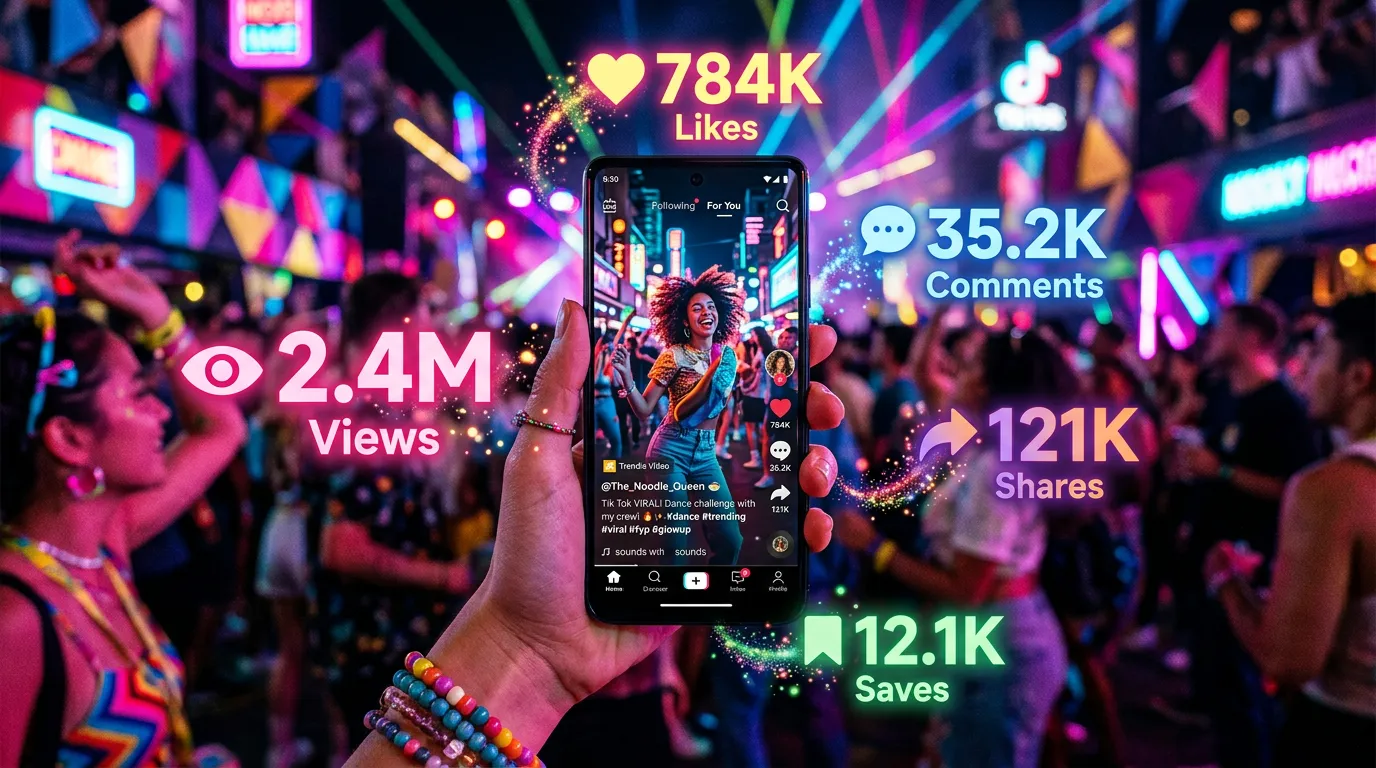
TikTok ads that blend in with organic content tend to outperform ads that look like ads. The skill is creating something that feels native to the feed — vertical, fast, and authentic — rather than a polished TV spot dropped into a phone screen. AI makes producing that native-feeling content faster and far cheaper, which is what lets you test enough variations to actually find a winner. The TikTok Ad Creator packages the whole flow so you can go from product to ready-to-post ad without an editing suite.
What is the proven TikTok ad formula?
Most ads that work on TikTok follow the same three-part structure. It's simple, but each part has a job.
Hook (first ~3 seconds): Capture attention immediately. A viewer decides whether to keep watching or scroll within the first few seconds, so the opening has to earn the next one. Use a bold visual, a surprising statement, a relatable problem, or motion that's impossible to ignore. This is the single most important part of the ad — if the hook fails, nothing after it matters.
Value (the middle): Deliver the message. Show the product doing its job, demonstrate the benefit, or tell a quick story. Keep it dynamic — fast cuts, movement, and on-screen text hold attention better than a slow, static demo. Get to the point a scroller actually cares about before the energy dips.
CTA (the close): End with one clear, specific call to action. "Shop now," "Try it free," "Link in bio." Vague endings leak conversions; tell the viewer exactly what to do next and make it feel like the natural last step.
How does AI build each part of a TikTok ad?
You can generate every component — visuals, copy, and audio — and assemble them, instead of shooting and editing from scratch.
Visual content
- Turn a single product photo into a product-in-context video using a reference-to-video model.
- Generate lifestyle scenes that feel shot-on-phone rather than studio-perfect.
- Add motion graphics and text overlays so the hook reads even with sound off.
- Produce multiple visual variations from the same concept for testing.
For the underlying motion, Popcraft uses Seedance 2.0, which animates a product photo into vertical 9:16 video at up to 1080p and clip lengths in the rough 4–15 second range — exactly the format and length window a TikTok ad lives in. You can drive it directly from the video generator or through an ad template that pre-sets the framing and pacing.
Copy and script
- Write hooks that match formats already working on the platform.
- Generate full ad scripts aimed at holding attention through the value section.
- Produce captions and hashtag suggestions.
- Localize scripts into multiple languages for global campaigns without re-writing from zero.
Audio
- Generate background music in a trending, platform-native style.
- Create natural-sounding voiceovers instead of robotic text-to-speech.
- Layer in sound effects that punctuate cuts and reveals.
A multi-track timeline lets you stack the video, voiceover, music, and effects and tune their timing together, so the hook line lands exactly on the opening visual.
What are the best practices for TikTok ads?
1. Vertical, always. TikTok is a 9:16 surface. Design every element for vertical viewing and keep products, text, and faces centered so nothing critical gets cropped or hidden behind the interface across different devices.
2. Start strong. Your first frame does more work than anything else in the ad. Bright color, a tight close-up, a motion that resolves, or a text hook all give a reason to stay. Because variations are cheap, generate a batch of openings rather than betting everything on one.
3. Keep it tight. Roughly 15–30 seconds is a reliable window. Cut anything that doesn't move the viewer toward the CTA — pacing is part of the message on TikTok.
4. Test broadly. This is where AI changes the game. Generating ten hooks and several CTAs used to be impractical; now it's a single session. Ship the variations, let real performance decide, and don't pre-judge which opening will win — the feed is full of surprises.
5. Stay current. TikTok trends move fast and go stale faster. The advantage of fast production isn't just volume — it's being able to create timely content while a format or sound is still relevant, instead of arriving a week late.
Native AI ad vs. repurposed polished video — which wins?
A common instinct is to take an existing brand video and trim it to vertical. It rarely performs, because it still reads as an ad. The native approach — built vertical-first, paced for the feed, with a hook designed for sound-off scrolling — fits the environment it's competing in.
- Repurposed polished video: fast to make from existing assets, but it telegraphs "advertisement," and the hook is usually a logo or a slow intro that loses the scroll.
- Native AI-built ad: starts from the format TikTok rewards, opens on a real hook, and is cheap enough to produce in many variants. The trade-off is that you're building for the platform rather than reusing, but that's exactly why it blends in.
If you only do one thing, build the ad native-first rather than retrofitting a horizontal asset.
What kinds of hooks actually stop the scroll?
The hook does the heavy lifting, so it's worth having a few reliable patterns to generate variations against rather than reinventing the opening every time:
- The problem hook: open on the frustration your product solves, stated or shown in the first beat. It works because a viewer who has that problem instantly sees themselves.
- The result hook: lead with the end state — the finished look, the clean result, the "after." Curiosity about how you got there carries them into the value section.
- The pattern interrupt: an unexpected visual, motion, or statement that doesn't look like an ad. It buys you the next second, which is all the hook needs to do.
- The relatable moment: a small, true scenario your audience recognizes. Authenticity reads as native, and native content gets the benefit of the doubt.
The point isn't to pick one — it's to generate several openings across patterns and let the feed tell you which resonates. Since each variation costs you little, breadth beats betting on a single clever idea.
How do you measure and improve AI-generated ads?
Production speed only pays off if you read the results and feed them back into the next batch. Watch a few signals:
- Hook rate — the share of viewers who watch past the opening seconds. This tells you whether your first frame and hook line are working, independent of the rest of the ad.
- Completion rate — how many watch to the end. A strong hook with a weak middle shows up as a good hook rate but a falling completion rate.
- Click-through rate — whether viewers act on the CTA. If completion is high but clicks are low, the close is the problem, not the content.
- Cost per result — your efficiency metric, the one that decides which variations to scale and which to retire.
Read the variations against each other: the hook rate diagnoses the opening, completion diagnoses the middle, click-through diagnoses the CTA. Then regenerate the weak part and re-test. AI makes that loop cheap, so the limiting factor becomes how clearly you interpret the data — not how much you can afford to produce.
You can build and test your first TikTok ad before paying anything: Popcraft is free to start with 100 credits, no card required, and the output is cleared for commercial use, so what you generate is ready to run as a real campaign.