

- Video
- Tips
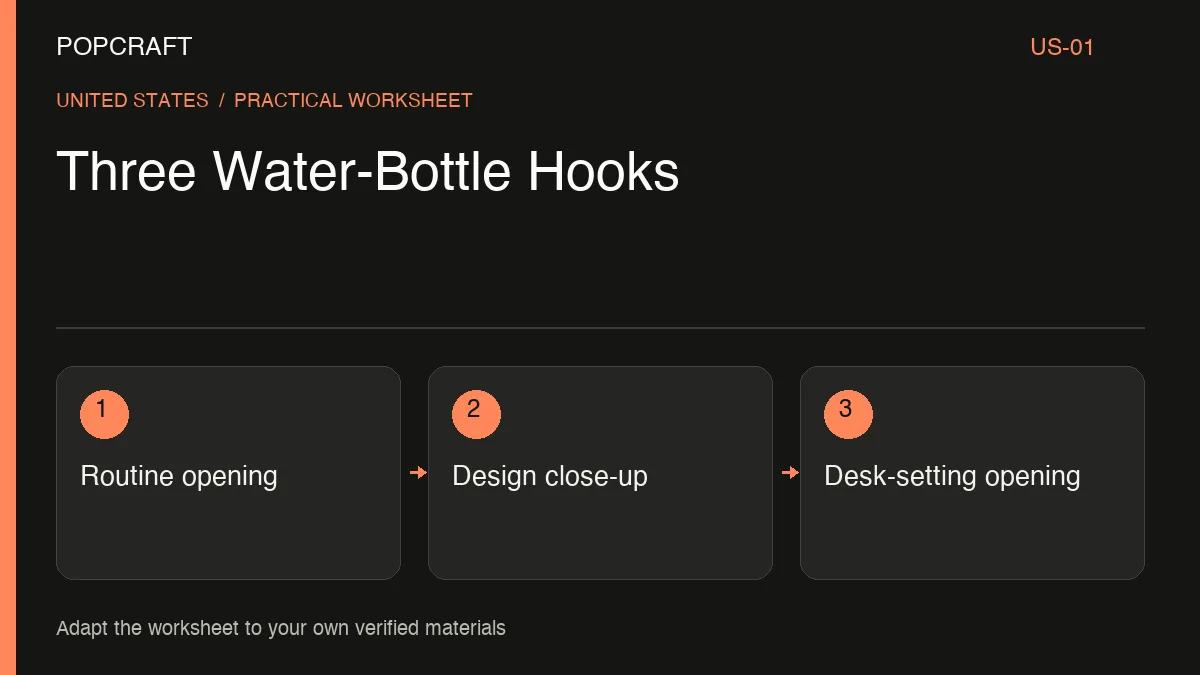
Three Water-Bottle Ad Hooks You Can Compare Fairly
A reusable water-bottle brand needs three opening ideas, not three unrelated ads. Keep the product facts and production choices fixed so the team can identify which creative idea it wants to develop.
This hypothetical brief uses a bottle whose appearance has been approved from real product photographs. Capacity, insulation, leak resistance and environmental claims remain outside the script unless the brand supplies evidence for them.
Fill these three hook cards
Card A — the forgotten object
Opening: “Phone. Keys. Water bottle. Ready to leave?” Visual: the bottle beside a phone and keys. Question being explored: does an everyday departure routine communicate the product clearly? Reject a take if the bottle changes shape or the scene implies an accessory is included.
Card B — the design close-up
Opening: “Meet the bottle up close.” Visual: a restrained close-up of the supplied product. Question: is its appearance interesting enough to carry the opening? Reject invented logos, closures or surface textures.
Card C — the desk reset
Opening: “A fresh start for your desk.” Visual: the same bottle on a simple desktop. Question: does a specific setting make the product easier to place in daily life? Reject an unsupported hydration or productivity promise.
Give every card the same approved closing invitation, such as “Explore the available colors.” These lines are illustrative creative, not customer quotations.
Copy this comparison record
Create one record per candidate:
Fixed: product reference, presenter if used, closing line, duration, aspect ratio, model and generation settings.
Changed: opening card A, B or C.
Observed: product accuracy, opening clarity, spoken-line accuracy, distracting artifacts.
Decision: develop, revise or reject, with one specific reason.
Result file: version name and the settings actually used.
Popcraft Studio can turn product references and direction into candidate videos. Start with one candidate per card and inspect them before expanding a batch. A prompt requests consistency; it does not prove consistency.
For a UGC-style version, direct a fictional spokesperson to introduce the bottle. Do not give the presenter an invented purchase history or personal testimonial.
The comparison record supports a creative decision, not a performance claim. If you later run a controlled advertising experiment, keep its delivery settings and actual results in a separate record. Review the live pricing and commercial-use terms before producing commercial campaign assets.
Related official tutorial
Related official video, in English: a general Popcraft product-photo-to-UGC workflow. It is supplemental production guidance, not a demonstration or result of the scenario above.